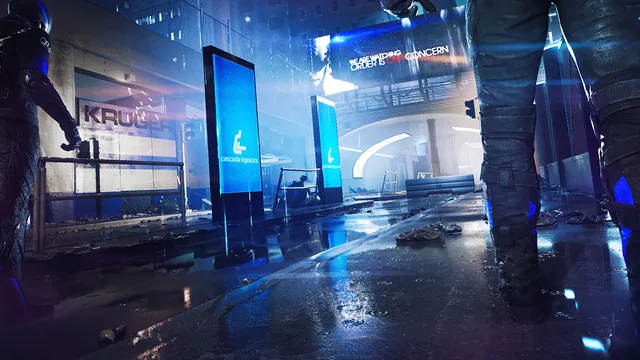
// Mirror's Edge Catalyst · Full story cinematics · Game capture courtesy of cakechieveables

Dialogue editing across Catalyst's story cinematics and the location dialogue that plays out around the city. Roughly the same job in two very different shapes, and in both cases the deliverable was a Pro Tools session the mixer could open and start mixing.
// Scope & Responsibilities
I cut dialogue on Catalyst on two fronts. The cinematics, which is Faith's story material and the scripted character beats, and the location dialogue that fires as you move through the city.
Cinematic work is the fussy end of it. Every line is locked to picture, so the edit has to sit exactly where the animation puts it, and any fix has to survive being watched as well as heard. Breaths, mouth noise, a chair creak two thirds of the way through the best take, a boom that drifts between lines. All of that gets dealt with before the mixer ever opens the session.
Location dialogue is a different problem entirely. Big line counts, delivered in batches, recorded across multiple sessions and not always in the same room. The job there is consistency. Every file has to land at a predictable level with a matched tone, so that when it goes into the game it behaves the same way wherever it triggers from and whatever it triggers next to.
Either way the target is the same. Hand over a session that's ready to mix, not one that needs repairing first.
// Tools & Pipeline
All of it was cut in Pro Tools. There are two tiers to it. Repair that gets rendered to the clip offline before anything else happens, and then the live insert chain that shapes what comes out the other side.
// Dialogue Processing Chain · Signal Flow
// Offline · Rendered to Clip
Not an insert. Processed onto the item file before it reaches the chain, so every stage below is working on already-repaired audio.
// Inserts · Dialogue Channel → Bus
Stage 00 is offline, rendered to the clip. Stages 01 to 07 are inserts on the dialogue channel. Stage 08 sits across the dialogue bus, treating the whole stem rather than individual lines.
Why the order matters
The de-click happens offline, on the item file, before any of it. Clicks, ticks and crackle are faults baked into a specific take. They aren't a decision you want to keep revisiting, so you fix them once at source and render it in. Leaving a de-clicker as a live insert means every pass recomputes the same repair on the same file forever, and it clutters a chain that should only hold things you actually want to keep adjusting.
Then the Oxford DeNoiser, and that goes before the compressor. A compressor pulls the loud and quiet parts of a signal closer together, then make-up gain lifts the whole lot back up. Room tone, hiss and air handling noise all live in the quiet parts. Compress first and you aren't just leaving that noise in, you're actively hauling it up in the gaps between words and then modulating it every time the actor speaks. That's where the breathing, pumping noise floor comes from, and nothing downstream really fixes it. Clean it while the floor is still steady and the compressor never knows it was there.
De-essing sits after the compressor rather than before it, and that catches people out. A compressor mostly reacts to the body of the voice, which means sibilance slips underneath it and then gets lifted by the make-up gain along with everything else. Tame the esses first and the compressor just hands them straight back to you. Let the level settle, then deal with what's left.
Two EQs, doing two different jobs
The first Pro-Q goes in after the de-esser and it's the surgical one. Room resonances, proximity build-up on a close mic, rumble under the take, the odd honk where a booth has coloured something. All of it is corrective, and it wants to happen once the level and the top end have stopped moving around, because an EQ decision made on an unstable signal doesn't hold up across a batch of a few thousand files.
The second one goes after WNS and before the limiter, and that placement is the whole point of it. Any suppressor takes energy out of the spectrum, and even a well shaped one leaves the voice slightly duller and a bit more closed in than it went in. The second EQ is there to put that back. It's broad, gentle, mostly a little air and presence, nothing surgical. You're restoring what the cleaning cost you rather than fixing a fault.
There's a practical reason it has to sit before the ML4000 as well. EQ changes peak level. Boost anything after a limiter and you've just walked straight back through the ceiling you set, which defeats the point of having put one there. Last tonal decision, then limit, in that order.
Two passes at the noise, not one
WNS goes late, right on the edge before the final EQ and the limiter, and it's doing a different job from the Oxford pass up front. That first pass is deliberately gentle. Hit a raw take hard with suppression and you pull the life out of it, so the aim early on is to get the floor down far enough that the compressor behaves, and no further.
That leaves something behind, and the compressor then lifts it. So WNS gets a second, targeted go at the residue at a point where the signal is already level and predictable. That matters more than it sounds. A suppressor works off per-band thresholds, and thresholds only behave consistently when the material arriving at them is consistent. Put it first and you're constantly chasing it from line to line. Put it after the compressor and the de-esser and one setting holds across a whole delivery.
ML4000 then goes last on the channel, catching plosives and the odd overshoot so nothing reaches the bus with a rogue peak on it. The bus compressor does the gluing, and that's the only stage where I'm treating the dialogue as one thing rather than as a few thousand separate files.
None of this is a preset. It's a starting position that gets pulled apart per actor, per session and occasionally per line. But the order of it stays put, because the order is the part that stops each stage undoing the one before it.
What WNS is actually doing
WNS is a broadband noise suppressor rather than a noise-print tool. It doesn't take a fingerprint of the room and subtract it, which is what RX or X-Noise do. It splits the signal into six frequency bands and watches the level inside each one continuously, pulling a band down when the signal in it drops towards the noise floor and opening it back up when there's speech present. Think six very fast, very well behaved expanders working per band rather than a spectral repair tool.
That distinction is exactly why it earns the late slot. A print-based denoiser wants a fresh fingerprint every time the room tone changes, and on a game with line counts in the thousands recorded over months across more than one studio, that's hours of your life you don't get back. WNS tracks the floor continuously instead, so it copes with whatever the earlier stages left behind without being re-taught on every batch.
The bell curve is the part worth explaining. Each band has its own threshold and range, and the display lets you shape how hard the suppression works across the spectrum instead of applying it flat. Flat suppression is what makes dialogue sound dead. You strip the air off the top and the body out of the bottom along with the noise, and the voice ends up thin and slightly underwater. Pulling a bell weights the suppression towards the region actually carrying the problem, usually the mid-upper area where hiss and air conditioning sit, and leaves the bands carrying the weight of the voice and the top end close to untouched. You take the noise out of the part of the spectrum where it's audible and leave alone the parts that make the voice sound like a person in a room.